What my archetypes taught me about how I work
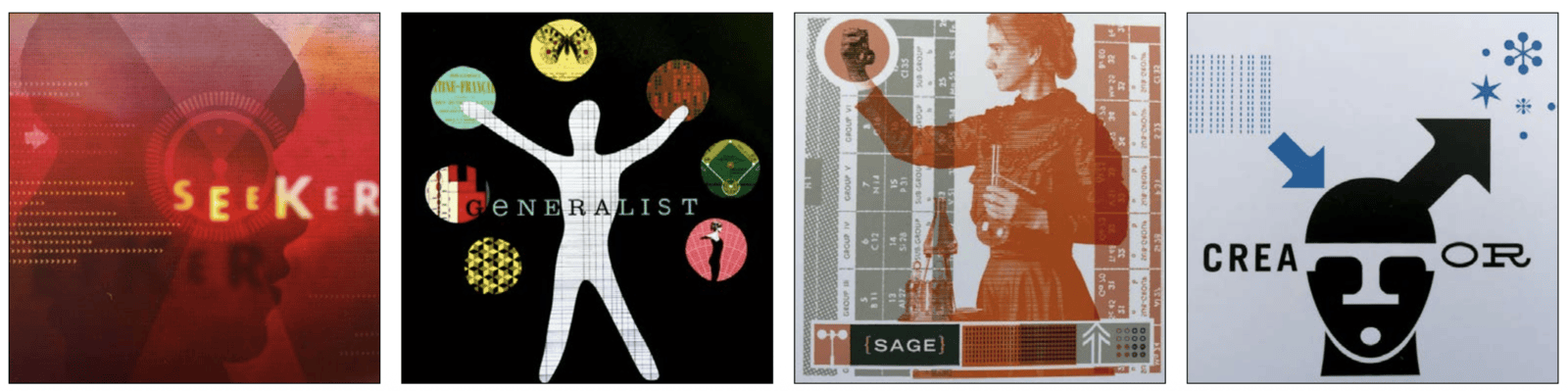
This morning I completed an archetypes assessment with Annalise Lewis from Manifesto, using a process that works through 60 archetypes and then considers how the strongest ones relate to one another. From this process six archetypes rose to the top, which we whittled down to four:
Seeker
Driven to continuously learn, grow and expand. This archetype is ambitious and independent, is in perpetual motion and travels lightly. Demonstrating great patience and perseverance, the Seeker stays on a path to find wisdom and truth wherever it may be, leaving no stone unturned or unexamined on the journey. The Seeker connects with the self and arrives at inner meanings through the exploration of the external environment. Driven to know more, the Seeker thirsts for a better way, a better life and a better world.
Strengths: Tireless inquiry. Honesty. Self-reliance. Flexibility. Open mind-set.
Challenges: Escapism. Loneliness. Tunnel vision. Susceptibility to being deceived. Greater interest in discoveries than in people.
Generalist
Also known as the Renaissance Person, is enchanted by the diversity of great stimuli available from culture, science, knowledge and the arts, and possesses an underlying belief that the world is a ready treasure trove of experiences. Thriving on being well-rounded and aspiring for competence in many areas, the Generalist can fill gaps, promote orthogonal thinking and awaken unseen connections. Breadth does not equate to superficiality but rather to a broad understanding of how the world operates.
Strengths: Expansive breadth of interests. Open-mindedness. Diverse talents. Nimble and facile mind.
Challenges: Tendency to overstate or overrepresent expertise. Prone to dabble. Lack of respect for mastery.
Sage
Motivated by independence, cognitive fulfillment and truth. This archetype has a foundational identity attachment to the belief that thinking is what defines the human experience. The Sage responds well to expert opinion but is inherently a pragmatic skeptic. Possessing a high need for autonomy, the Sage values learning for its own sake because it allows for detachment from the masses and the capacity to remain objective.
Strengths: Wisdom. Intelligence. Truth seeking. Clarity of thought. Rational decision making. Prudence. Talent as a diligent researcher.
Challenges: Fear of being duped or ignorant. Susceptibility to feeling disconnected from reality. Dogmatism, righteousness or arrogance. Lack of action.
Creator
Has a passionate need for self-expression, to be a cultural pioneer. Creating offers a means of dealing with how out of control the world seems. The Creator is highly imaginative, with a developed sense of the aesthetic. This archetype often appears in environments that are reflective of good taste and a unique point of view. The Creator notices and acts upon the need for innovation, invention and reinterpretation. Believing in the value of inner expression, the Creator is dedicated, hardworking and achievement oriented.
Strengths: Creativity. Imagination. Nonlinear thought. Nonconformity. Developed aesthetic.
Challenges: Over-dramatisation. Depression accompanying a failure to make meaning. Perfectionism. Fear of mediocrity and judgment.
I've spent a fair amount of time thinking about identity, roles, and recognition, so it's really interesting to see a pattern like that described crisply in a typology developed by someone else. The four archetypes do not explain everything about me, of course, but they're a useful lens on my work.
But what does it all meeeeeean?
The Seeker is described as driven to learn, grow, and expand, in “perpetual motion” and travelling lightly in search of wisdom and truth. This feels familiar as much of my work has involved moving across contexts, spending enough time in each to learn something significant, and then moving on when the next question or opportunity appeared. I did Philosophy as an undergraduate, for goodness' sake.
The Generalist reflects my breadth of interests, open-mindedness, diverse talents, and an ability to connect across domains. The Manifesto report frames this archetype as a “Renaissance person”, someone who can fill gaps, promote orthogonal thinking, and spot connections that others might miss. This also feels close to how I work, especially when moving between education, technology, credentials, governance, and strategy.
The third archetype is the Sage, motivated by independence, cognitive fulfilment, and truth. The report describes the Sage as valuing learning for its own sake, responding well to expert opinion, and maintaining a pragmatic scepticism.I recognise that in my tendency to look for the underlying concepts before deciding what I think.
And there is the Creator: imaginative, non-linear, aesthetically oriented, and motivated by self-expression and innovation. This is the part of me that likes writing, designing, experimenting, and making sense of ideas by turning them into something shareable.
Three of these four sit in what is identified as the Explorer family, suggesting that most of my energy is directed towards movement through ideas and contexts, with only one of the four explicitly concerned with making something finished 🤔
Pattern recognition
One thing that stands out is how well this set of archetypes maps onto the shape of my working life.The Seeker wants to find what is not yet known, the Generalist wants to connect across many domains, the Sage wants to understand deeply and correctly, and the Creator wants to make something new from what has been gathered. That's not a bad description of how I usually approach projects!
It does raise the free will vs determinism question for me: how much of my work is shaped by deliberate choice, and how much by the fact that these archetypes make some kinds of activity feel more natural than others?
Given that there are 60 archetypes, based on Jung's original 12, it's interesting to reflect on what doesn't appear in my four. There's nothing associated with with belonging, nurturing, managing, or maintaining. That doesn't mean I don't have those capacities at all, rather that they're not primary drivers.
It probably also explains why I'm often more energised by starting, reframing, or reimagining than by maintaining established structures over long periods. There's also no 'Hero' or 'Warrior' archetype, suggesting I'm less motivated by winning or defeating an opponent, and more by understanding, exploring, and making.
That feels about right, although it also raises another question: what kinds of collaboration or support canhelp balance what is missing?
Reflection questions
The report ends with a set of reflection questions about neglected archetypes, stress responses, work, hobbies, purpose, and pride. I've got a follow-up session with Annalise next week, so I've reformulated these into:
- Which of these archetypes feels most at home in my current work, and which feels underused?
- What kinds of projects bring the strengths of these four into better balance?
- Which kinds of collaborators help compensate for what is less present in this set?
For now, that feels like enough. The value of this exercise is not that it produces a final answer about identity (there isn't one),but that it provides a sharper language for noticing patterns in how I think, work, and decide.