My 7-step approach for authentic AI-assisted blogging

On Wednesday, I was talking with my friend Jess Klein about my use of AI. Along the way, I mentioned how easy it is to tell when someone has just copied and pasted from an LLM – in fact, it's got to the point where I can even tell which model they've used.
When I shared how I approach writing for this blog, I realised that I had a 7-step process that I'd never written down. Jess suggested that it would make for an interesting blog post. So here we are.
Since moving to Ghost over the Christmas holidays, as well as my Sunday weeknote, I've maintained a rhythm of publishing on Mondays, Wednesdays, and Fridays. Full disclosure: that's only been possible because I treat AI as part of my writing and publishing workflow. Happily, I've had great feedback in terms of comments and private messages, an increased number of subscribers, and my work being shared more widely on social networks.
This post is recursive in the sense that I'm going to walk you through how the 7-step process applies to the creation of the very thing you're reading. I'm going to cover how I try to avoid creating AI slop, the ways in which I use an AI style guide, and what I talk about when I talk about “authenticity.”
At the end of the post I've shared three resources:
- Conversation with Perplexity that led to a draft post
- Raw version of the draft the LLM created
- My AI style guide
Enjoy reading how the sausage is made! 🌭
What am I even trying to do here?
Before I share the 7-step process, let's just take a step back and name what I'm actually trying to do when I use AI in my writing and publishing workflow:
- Maintain a publishing schedule that I find sustainable
- Share things that I've been thinking about which I consider worthy of other people's attention
- Ensure that what I publish feels like “me”
AI lowers the friction of getting from an idea I have while brushing my teeth to a draft that I can then iterate upon. Using an LLM, especially one I've been using a while like Perplexity, is conversational and contextual. And it means that I avoid the tyranny of the blank page.
When Cory Doctorow shared recently that he uses a local LLM as part of his workflow, people were not happy. So I'm donning the flameproof suit before hitting publish on this post 🔥
My 7-step process
Here's the process, broadly speaking, that I go through when creating a post to publish on this blog:
- Come up with an idea for a post
- Have a conversation with Perplexity
- Get it to generate a post (based on this style guide)
- Rewrite the post
- Run it through GPTzero.me
- Do another ‘editor’ pass through a different model in Perplexity
- Publish
💡 💬 Steps 1 & 2: Come up with an idea and have a conversation with Perplexity
Inspiration comes in many forms. I've published posts recently based on books I've read, conversations I've had, and podcasts I've listened to. In this case, it was a chat with Jess, who I've known for over 15 years at this point. I felt safe in conversation with her, and her encouragement mattered.
So on Thursday morning, while I was getting ready for the day, I was having a conversation with Perplexity. Sometimes that's voice-based, but usually when my wife and daughter are in, it's text-based, otherwise I get a shout from another room: "What did you say? Who are you talking to?"
If you have a look at the conversation I had, you'll notice that the initial prompt was reasonably long. I kind of know what I want to say, but I just want to hash it out with an interlocutor. Sometimes doing that right now (even if you're doing something else at the same time) can be useful.
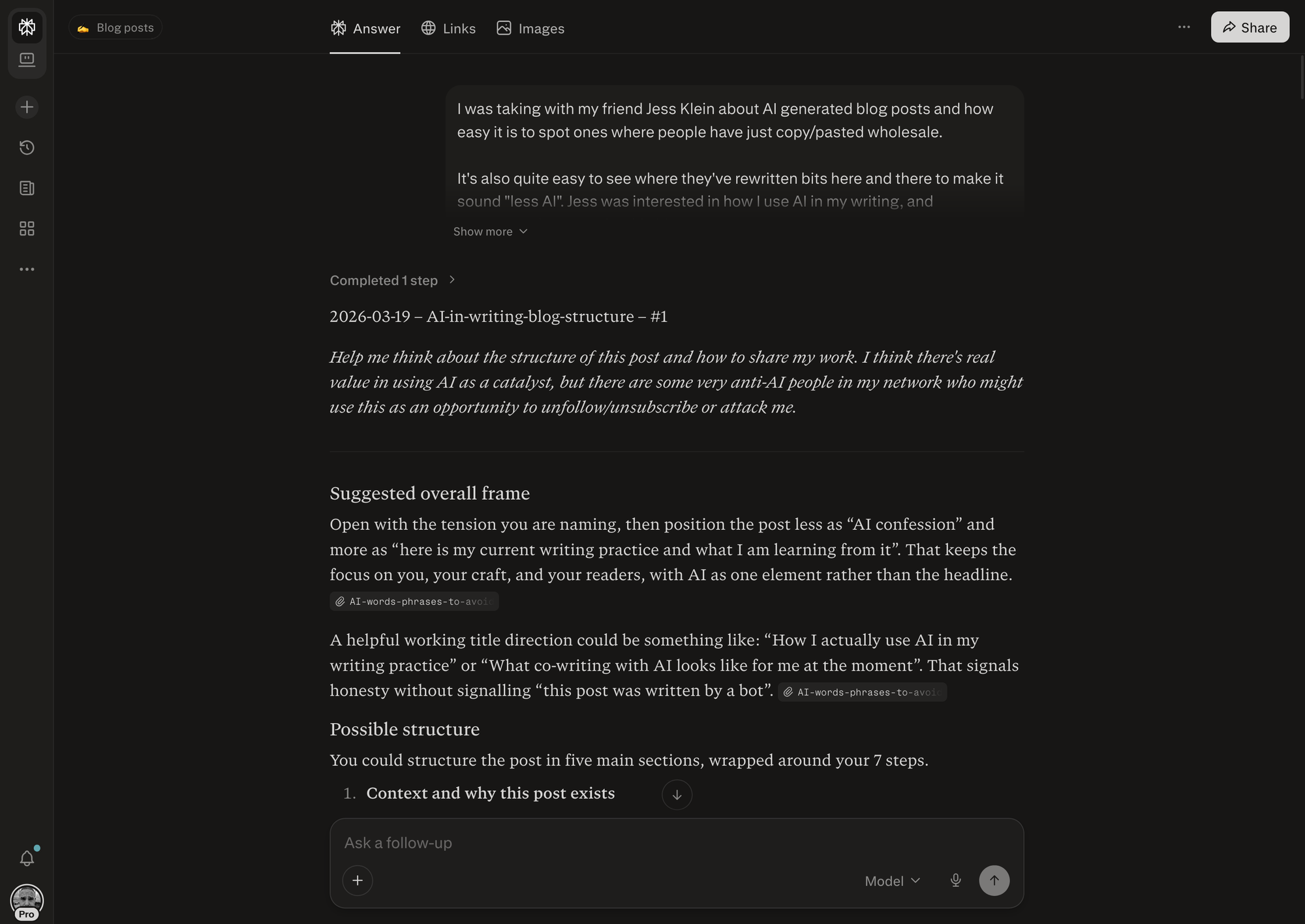
In the conversation for this post, I explored:
- Ways of structuring the post
- How to frame this as my situated practice rather than something prescriptive
- Ways to link this to academic theories
For example, I ended up rejecting an idea to include links to Donna Haraway's work because, although I spent some time reading resources, I didn't have time to sit down with them and read them thoughtfully.
📝 🤔 Steps 3 & 4: Get the model to generate a draft and then rewrite it
Once I'm happy with the structure and content, I then ask the LLM to generate a full draft based on our conversation. This is based on the style guide I've created, which is essentially telling Perplexity not to use (or overuse) certain words, phrases, and grammatical tics.
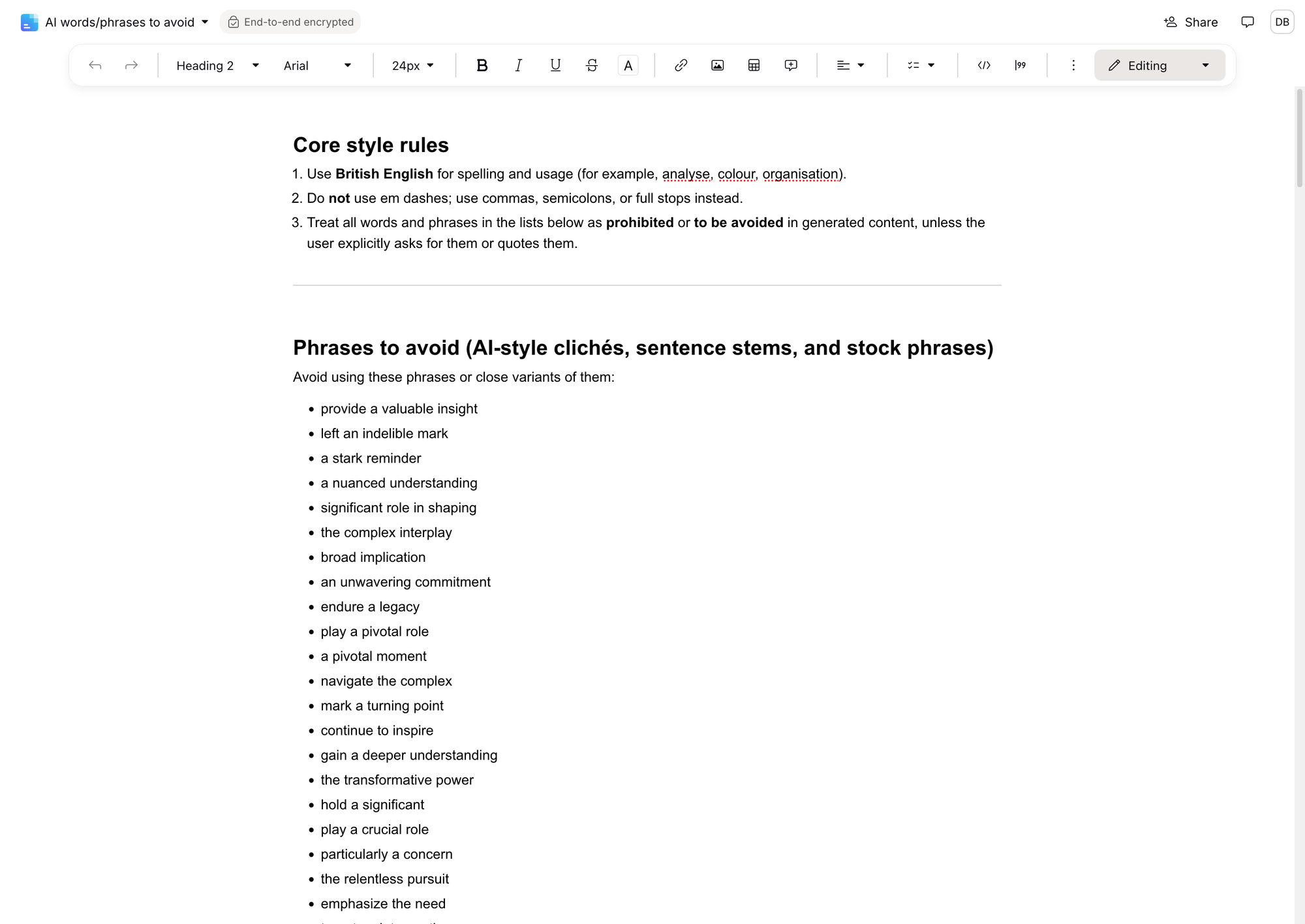
This leaves me with a draft that I should imagine many people would just hit publish on. Sometimes I ask it for suggestions for a title for the piece, sometimes I don't.
At this point, I'm on my laptop, so I copy/paste it into Ghost, the platform I use for this blog. This is my raw material. You can see the draft that Perplexity created for me here.
Next, and often at a different time, either on my desktop or laptop, I make the text my own. Sometimes I cut out whole sections if I don't think they're useful. I use my own voice and idiosyncratic way of writing. I add links where relevant.
So by the end of Step 4, the post feels like me even if I've had significant help with the structure and approach from an LLM.
✅🤖 Steps 5 & 6: Run through GPTZero and use a different LLM as an editor
Just as I do for all of my posts these days, once I've finished with this one, I'll run it through GPTZero to double-check. Sometimes, when I'm feeling tired or lazy, I tweak less than at other times. I'm not necessarily trying to get a 100% “human” score, but rather just check that I'm being honest with myself.
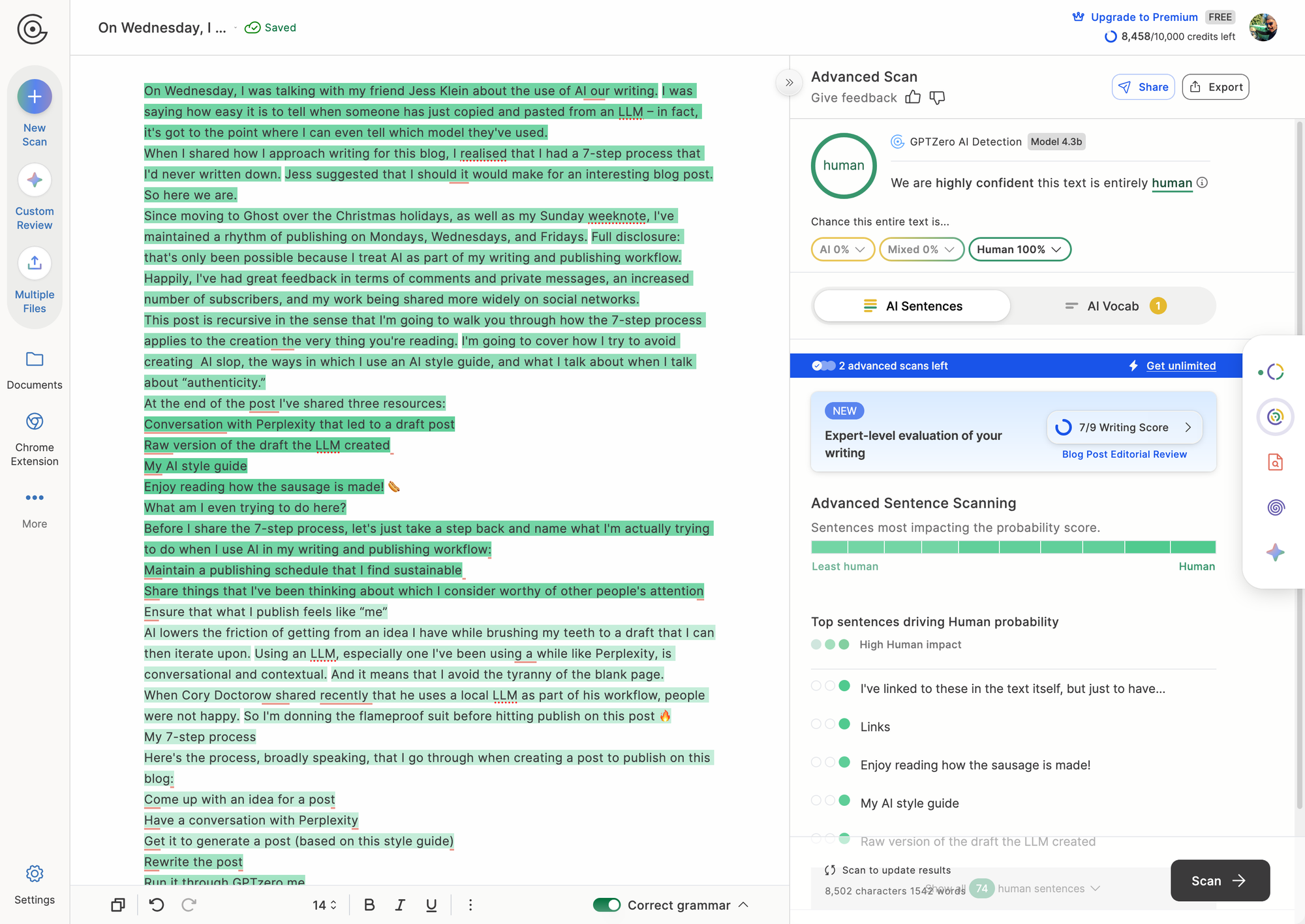
This is why I often end up publishing in the morning (UK time) as I tend to run Steps 5 and 6 just before I hit publish. Then, if I have been tired and/or lazy, I've got time to restructure and tweak.
(As an aside, it's interesting using that tool for other people's work. You see how often people write the introduction themselves, copy/paste the LLM output, and then tweak a few words here and there!)
The last step before hitting publish is to do what Cory Doctorow does, except with a more powerful model. I use different LLM (e.g. Claude) as an editor and ask it to find typos and grammatical errors. It's particularly good at also pointing out clichés and clumsy wording.
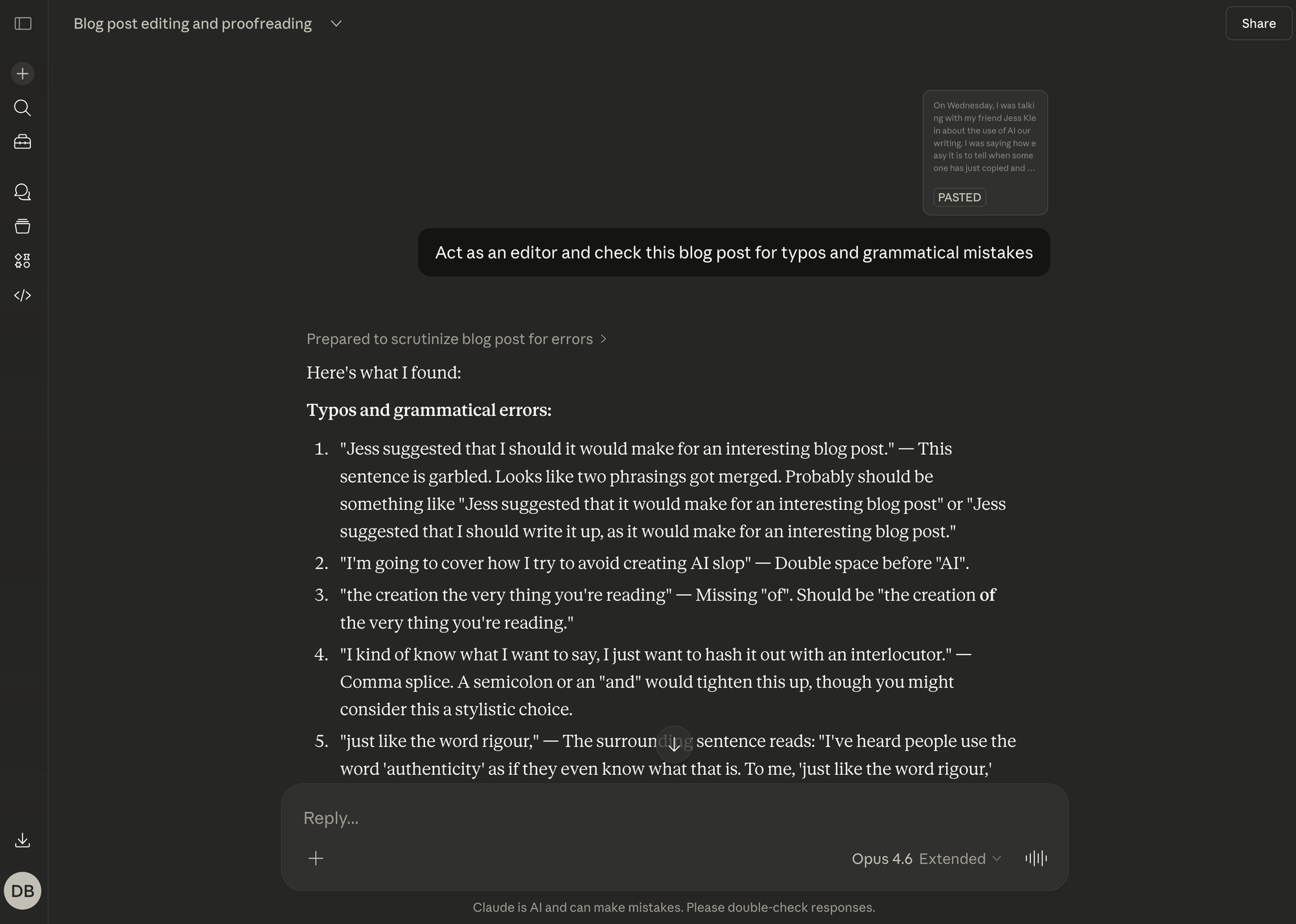
Sometimes I just ignore everything other than the typos, other times I restructure whole sections. The point is that it's a thoughtful process, not just asking it to “process” my text.
🎉 Step 7: Publish
The last thing I need to do is to find an image to accompany my post. Depending on how inspired I'm feeling, I'll ask an LLM for suggestions. Most of the time, though, I'm just exploring Unsplash.

Other than that, I just add the post metadata, then hit publish. Occasionally, I ask Perplexity to come up with short posts to promote the post on LinkedIn, Mastodon, and Bluesky. A lot of the exact details of Steps 5-7 depend on how much of a rush I'm in, to be perfectly honest.
This still feels like me
Having dabbled with AI since GPT 3, I'm used to the usual arguments against using AI for... well, anything. Often, and especially with writing, I've heard people use the word “authenticity” as if they even know what that is. To me it's a thought-terminating cliché, just like the word “rigour”.
To me, authenticity is a construct. It is not something that lives inside the text itself, but is rather a relationship between the writer, the reader, and their shared context.
I'm happy to share my work openly when:
- The ideas originate from my own experience, practice, and reading/listening
- The expression of those ideas sounds like me – even if AI has helped me along the way
- I'm willing to defend what I've published and answer questions about it
So, from this point of view, the use of LLMs in a writing and publishing workflow does not make something “inauthentic.” It's how the tools are used, and how willing you are to share your workflow. Jess challenged me to write this up – unless I'm somehow embarrassed about it? Which, of course, I'm not.
Posts I publish here are mine. I'm holding myself accountable for them, and you too should hold me to that, even if AI was involved in the process. If you're already using, or thinking about experimenting with AI in your own writing/publishing workflow, let me know how you're approaching it.
How are you thinking about all this?
Links
I've linked to these in the text itself, but just to have everything in one place:
- Conversation transcript with Perplexity that led to this post.
- Unedited Step 3 draft that I used as the starting point before rewriting.
- AI Style Guide which helps LLMs I interact with avoid sounding too “AI”