Cognitive Wallpaper #001: Field Notes on Productive Friction
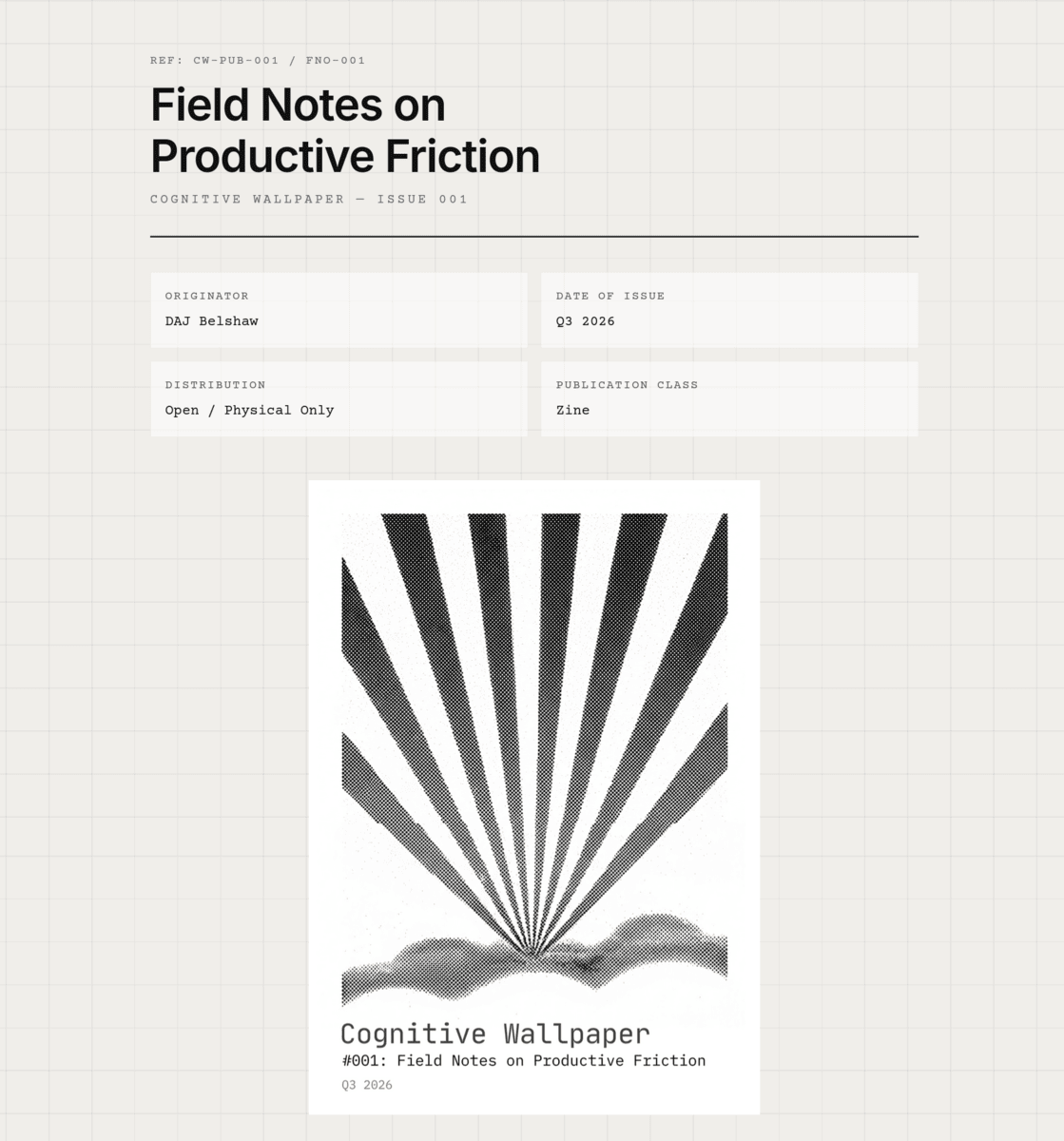
We no longer live in a deterministic world. As I discussed last week, ours is a time of probabilistic inference via algorithms and LLMs, with smooth tools producing bad thinking. And as I mentioned a couple of weeks ago inconvenience is sometimes a feature, not a bug. If we remove every point of friction, then we remove the points where reflection happens.
Cognitive Wallpaper – Issue 001: Field Notes on Productive Friction is a 40-page zine I'm working on about the textures of attention, the architecture of thought, and the patterns we mistake for productivity. It's going to contain eight patterns of digital capture, as noticing is the first step in doing something about it:
- Ambient nudging: modification of choice architecture in environments meaning that the user believes that they are operating under neutral conditions
- Default Capture: the process where a system retains access, data, or attention – not through active user consent, but the absence of an opt-out mechanism
- Notification Creep: the expansion in the frequency and urgency of interruptions until the user is only paying persistent partial attention
- Frictionless Onboarding: deliberate removal of decision points during the initial adoption of a system or platform, which results in commitments that the user did not realise they were making
- Algorithmic Substitution: the replacement of human curation, memory, or discovery with an opaque automated system
- Surveillance as Convenience: reframing of data extraction as a “user benefit”, meaning that the user actively assists in their own monitoring
- Quantified Self Trap: the belief that self-knowledge is available primarily through numerical representation, relegating qualitative experience as an “unreliable” or “inferior” data source
- Exit Barriers: structural, psychological, and social costs imposed on users who attempt to discontinue a service or behaviour
- Self-Administered Audit Protocol: a standardised procedure to evaluate your own technological dependencies, without the assistance of the systems under evaluation.
I'm aiming for the zine to be the kind of thing you might read on a train – and then spend the rest of the journey uninstalling apps and adjusting your notification settings.
The design is deliberately bureaucratic and deadpan, channelling There Is No Antimemetics Division by qntm. The cover is a homage to Shigeo Fukuda, the Japanese graphic designer, and the text is mono and appropriately zine-y.
The physical format owes a debt to Jay Springett, whose zines have arrived regularly through my letterbox over the last few years. There's a particular delight in holding someone else's thinking in your hands, in ink on paper; the medium is part of the message.
This zine connects to work I have been doing this year on attention, agency, and the default settings of digital life. It also connects to a couple of decades of writing about digital literacies, web literacies, and (more recently) AI literacies. The thread being that literacy isn't just about using tools competently, but about noticing which tools are using you.
I'm planning to print 50 numbered copies. There might be a second print run, but there's not going to be a digital version. The point, in part, is the friction: you have to wait for it to arrive.
Find out more at cognitivewallpaper.com, or if you can't wait, just smash the button below.