First draft of Mozilla's Web Literacy standard now available!
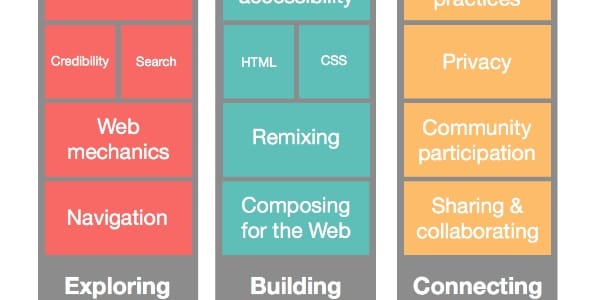
I’m excited to announce that, after some fabulous work by my colleagues and the community, the first draft of Mozilla’s Web Literacy standard is now available:
We’ll be launching a ‘beta’ version in June which will be flesh out the competency-level grid and descriptors that make up this tentative first release.
The best way of thinking about the grid is as the areas that we think it’s important to pay attention to when teaching others how to read, write and participate on the Web.
I’d like to thank those who have been involved in this (ongoing) process and I’m very much looking forward to hearing further feedback, which you can give in several ways:
- In the comments below
- Using this feedback form
- On the weekly community calls
Please do feel share to share the URL at top of this post with your networks. It would be good to get as many eyes on this as possible. 🙂
Competency-level grid

Competency descriptors
EXPLORING
Navigating the Web
- Navigation – using software tools to browse the Web
- Web Mechanics – understanding the Web ecosystem
- Credibility – critically evaluating information found on the Web
- Search – locating information, people and resources via the Web
- Security – keeping systems, identities, and content safe
BUILDING
Creating for the Web
- Composing for the Web – creating content (including text, images, audio and video) making use of Web technologies such as hyperlinks
- Remixing – using existing (openly-licensed) content to create something new or modified
- HTML – reading and writing HyperText Markup Language using the building blocks of the Web
- CSS – reading, writing, testing and applying Cascading Style Sheets to change the visual appearance of HTML
- Design & accessibility – creating universally effective communications through digital artifacts</li>
- Coding/scripting – creating interactive experiences through digital artifacts for the Web
- Infrastructure – understanding the Internet stack and how to host your own data
CONNECTING
Participating on the Web
- Sharing & Collaborating – providing access to digital artifacts, understanding data ownership and jointly curating or creating content
- Community participation – getting involved in Web communities, understanding and respecting online norms and practices
- Privacy – working with intellectual property, examining and understanding the consequences of sharing data online
- Open practices – championing, creating, and protecting the Web as a platform for democratic, universally accessible innovation