Developing agency among agents via 'hypertextual friction'
I mentioned in my last post how important 'friction' is to an individual's digital skills and construction of a mental model of digital ecosystems. This morning, via Are.na's last newsletter of the year, I discovered an academic paper talking about something similar:
The web has become increasingly agentic—and increasingly opaque. Interactions with digital information, once defined by human-authored trails, are now dominated by algorithmic feeds and generative systems that anticipate user needs before intent is even articulated. This shift reflects more than a change in interface design; it signals a broader transformation in the structure of the web itself—one that enacts a technocapitalist worldview of efficiency, optimization, and seamlessness.
We draw from prior work that reimagines friction not as a flaw but as a meaningful affordance in interaction design—and offer a provocation: What if we revisited the friction of hypertext, not with nostalgia, but as a speculative framework for reclaiming agency?
Here, agency means more than the ability to click or customize. It is the capacity to navigate, trace, and compose meaning across a digital landscape. Where algorithmic systems guide users down invisible, pre-optimized paths, hypertextual systems foreground connection and deliberateness.
Using the word 'hypertext' might feel old-fashioned, but it's a constructivist and very human approach to co-creating the web. The authors of the paper, Sophia Liu and Shm Garanganao Almeda, propose a "conceptual design stance" termed Hypertextual Friction which treats "friction, traceability, and structure as values for reclaiming agency in hybrid systems."
Again, as I discussed in my last post, the way things are going, life could look very different in a decade's time. Much, I suppose, as life in 2025 looks quite different to 2015 – and a lot different compared with 2005. For better or worse, AI use is likely to be ubiquitous.
 Robert Booth
Liu and Almeda are less interested in the societal effects of AI and more interested in the epistemological implications:
Beyond technical frameworks, artists and theorists have revisited hypertext as a lens for authorship and agency. In their performance lecture "Becoming Hypertext," artist Chia Amisola explores hyperlinking as a mode of personal and epistemological authorship—arguing that "readers are also authors," and that "linking is also authorship." Their work reimagines hypertext not just as a technical structure, but as an expressive, embodied form of navigating and composing meaning.
Our work builds on this momentum by advocating for a design stance we call "Hypertextual Friction"—not because hypertext and friction are synonymous, but because the structures of hypertext—visible connections, associative trails, deliberate navigation—create the kinds of friction that support agency.
These visible connections and associative trails are part of what drew me to Are.na back in 2018 as a design influence for MoodleNet. Coming back to it seven years later is a revelation. It's "social" in a way that makes you feel like you're building something – both individually and with others. I really like it.
Back in 2018 it was clear that there was a big difference between a chronological feed and an algorithmic feed. What's even clearer in 2025 is the difference between different types of user-facing algorithmic systems:
While all computational systems rely on algorithms in a technical sense, we use the term "algorithmic systems" here to refer specifically to an interaction design paradigm that centers predictive, generative, or adaptive outputs driven by computational models or agents. These include recommendation engines (e.g., Spotify’s song recommendations), feeds curated by recommendation engines (e.g., TikTok’s For You page), and agentic assistants (e.g., ChatGPT, DALL·E, and GitHub Copilot).
Such systems streamline experiences, removing the need for explicit navigation. Content is surfaced, suggested, or produced automatically, shaping interaction around prediction and immediacy. In many cases, the underlying logic, selection process, or data provenance is hidden from view.
This is contrasted with hypertextual systems such as Wikipedia, Obsidian (a personal knowledge base), or Are.na which focus on "manual exploration and associative thinking."
What I appreciate about the paper is the way they don't argue that we should go back to a purely hypertext approach, but rather suggest that there are hybrid ways forward. The example they give is just generating an image based on a prompt, versus first creating a mood board to refine ideas.
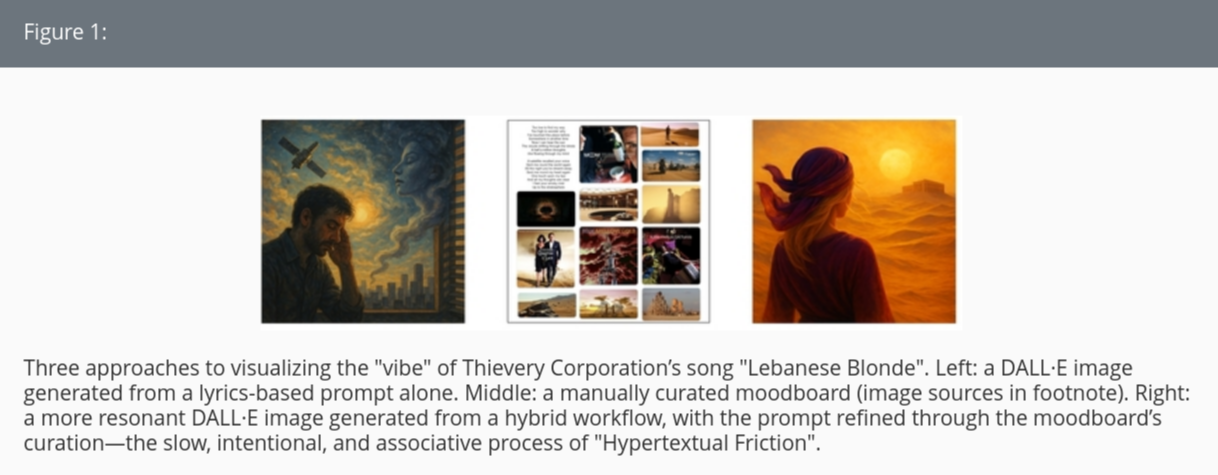
This process became a kind of hypertextual composition, where each image or reference led to the next. Meaning wasn’t just generated—it was curated through a frictive, slow, and intentional process. We returned to DALL·E with a screenshot of the moodboard and short personal narratives written during reflection in Freeform. The resulting image resonated more—not because the model improved, but because the input was shaped by intentional labor. Meaning emerged from the path, not the endpoint. This illustrates how GenAI systems can benefit from hypertextual scaffolding—not to optimize output, but to foreground reflection, authorship, and agency in the creative process.
This resonates quite nicely with work I've done around digital literacies. For example, this slide deck builds on work from my doctoral thesis showing how literacies can be plotted on two different spectrums. These can then be mapped against each other, creating four quadrants:
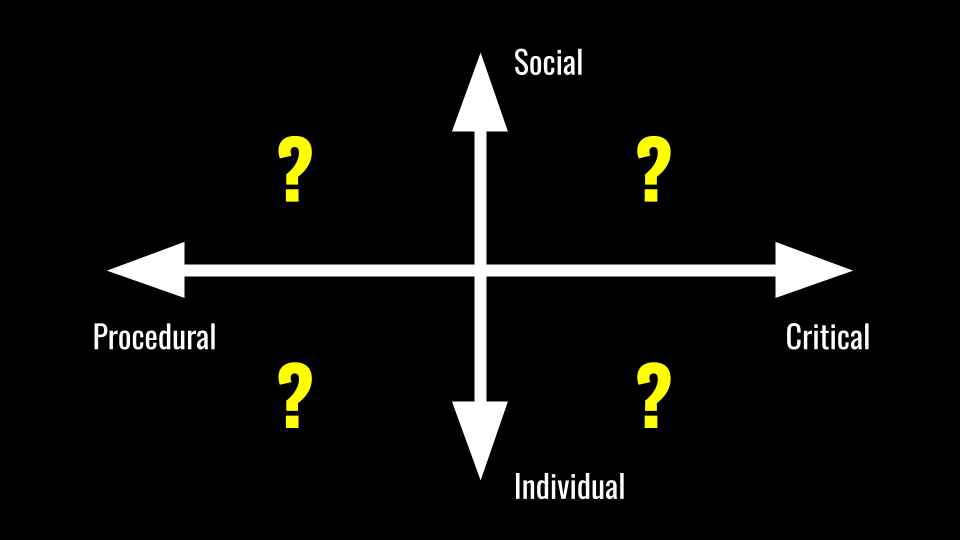
An example of something that is 'social' and 'critical' might be contributing to a Wikipedia article. This involves what I would term the constructive, critical, and civic elements of digital literacies as it involves a nuanced understanding of the "rhetorics of communication" required in such a space.
I'll be using the term hypertextual friction in future, crediting Liu and Almeda for coming up with such a useful term. I'm also a big fan of their foregrounding of agency in a world where AI can seemingly do most things for us:
Agency among agents requires more than good prompt engineering. It calls for structural alternatives. In this light, hypertext offers more than critique—it offers a design path forward.