Badges that change shape to show skills development
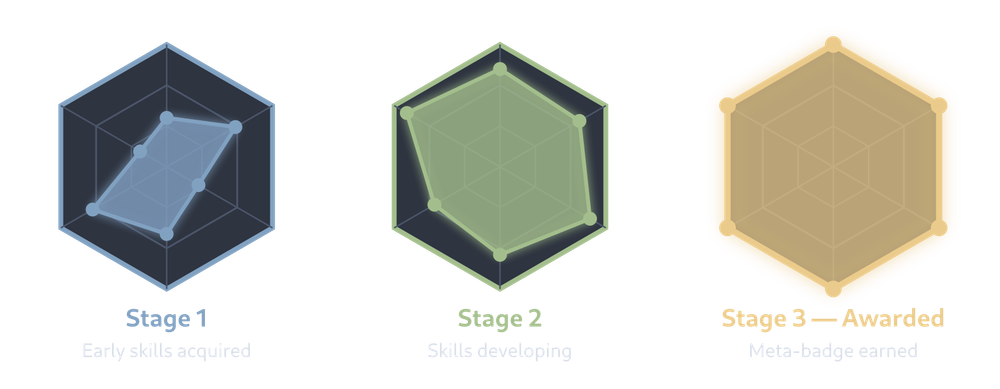
It's been a while since I talked about Open Badges, “a type of digital badge that is verifiable, portable, and packed with information about skills and achievements.” It's something I've been interested in for 15 years at this point, and I was on Mozilla's badges team back in the day.
In this post, I want to talk about something that Kerri Lemoie mentioned a while ago, and which I was talking about with Don Presant and Serge Ravet this week. Namely, badges that change shape to show skills development. It's something I've thought about for years, ever since seeing the (now-defunct) Workshape.io website.
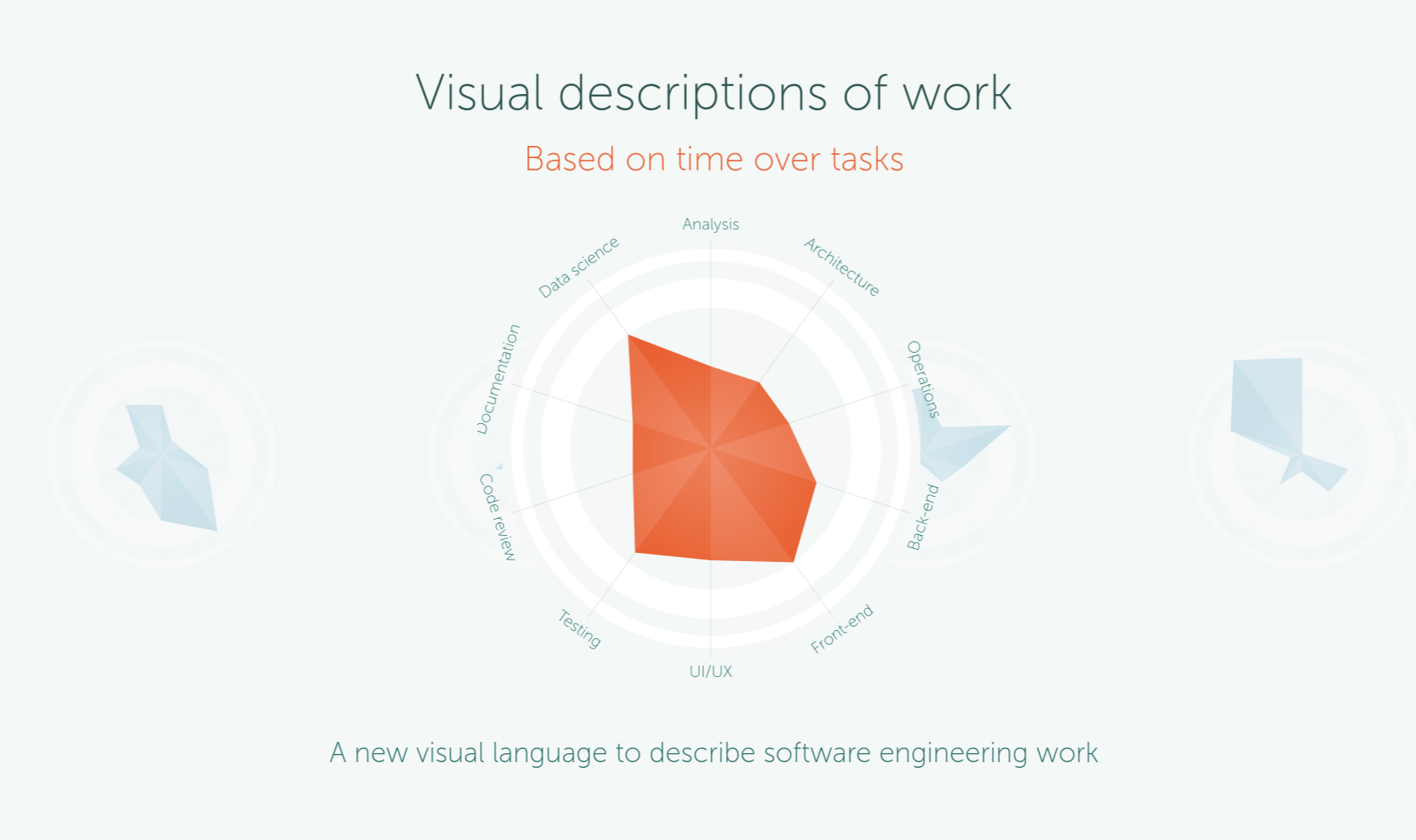
Let's use the image at the top of this post as well as the one above to guide our imagination. Consider a badge that isn't a fixed image: instead of something static that suggests the binary of something being completed or not, it's a polygon. The badge is a radar plot demonstrating recognition of a learner's development over time.
Let's dive in a bit further.
What badges could be
The technical standard behind Open Badges has improved enormously over the years. The latest version, Open Badges v3, uses the Verifiable Credentials data model, which is the same data model used for things like digital identity documents. This makes badges more portable, more trustworthy, and harder to fake. It also makes the badge image optional, meaning it's now a view of the data, rather than containing the data itself.
So, if the image is just a view, that view can change. We can generate it from the underlying recognition data instead of fixing it at the moment of issue. Badges become mini e-portfolios, able to show progression. They can show the journey as it is happening.
Perhaps the closest mainstream equivalent to a “changing credential” is the GitHub contribution chart. Here's mine:
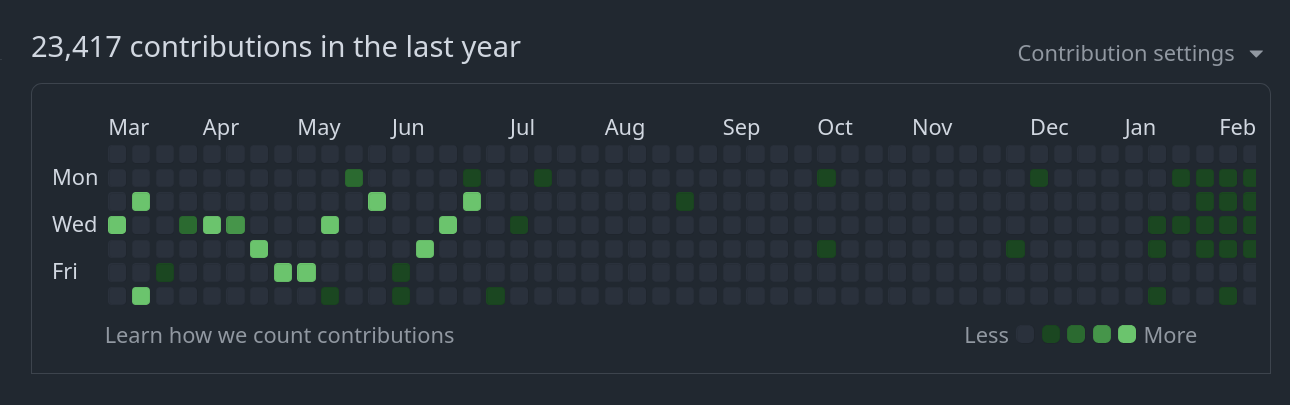
This grid of green squares that fills in as you commit code has become surprisingly meaningful in developer culture – to the extent that some people write scripts just to keep it green! It's also a thin kind of credential, showing activity rather than practice. It tells the viewer nothing about collaboration, documentation, care, or context. Everything is flattened to a single dimension: were you active today?
A radar chart, as shown in the image at the top of this post, is different. It contains multiple axes, each representing a dimension of practice. The shape of the polygon determines how far someone's development has been recognised. Two people, for example, could have the same overall “size” of polygon but completely different shapes. And the shape can change over time as recognition of their learning and development is added.
What the axes could represent
In the Workshape.io example, they use 10 different types of common activities that developers perform. Things like analysis, front-end development, and code review.
Axes are not neutral, and choosing what goes on each axis is a decision that each community needs to make about what is worth recognising. Badge design is recognition culture made visible.
As well as simply adding different competencies to the axes, here are some examples of the kinds of things that could be represented on a polygonal badge, guided by Serge Ravet's excellent Recognition Practices Occupational Framework:
- Dimensions of practice – for recognition practitioners, the axes could include things like:
- Facilitating peer recognition
- Documenting contributions
- Working across institutional boundaries
- Developing recognition literacy in others
- Advocating for non-formal recognition in formal systems.
- Modes of recognition – the axes could also help distinguish different types of recognition. This is a great way of differentiating between someone who is highly regarded by their peers but invisible to formal systems vs. someone with all of the credentials but no presence in relevant communities.
- Informal recognition (e.g. a thank-you, a citation, an invitation)
- Semi-formal recognition (e.g .a community badge, a peer-validated portfolio)
- Formal recognition (an accreditation, a licence)
- Levels of context — the badge axes could show at what scale someone's knowledge, skills, or dispositions have been recognised:
- Micro (individuals and small groups)
- Meso (organisations and communities)
- Macro (sectors and public policy)
These, of course, are not mutually exclusive. Someone with better design skills than me might be able to layer multiple polygons on the same grid. The result would be more like a map than a medal.
Next steps
I've got more to say on this, but I'll leave it there for today. Just a quick note on the technical side: I think this is the easy part. The Open Badges specification allows for SVGs (Scalable Vector Graphics) which is actually a text-based image format. So a radar chart in SVG is just a polygon where the vertices are calculated from a set of numbers.
This means that an issuing platform or wallet could generate the image directly from the credential data, and regenerate it whenever new recognition data is added. SVG's are super-accessible as well, as they can carry with them alternative text descriptions and structured metadata. So the polygonal badges can be read by humans and machines alike.
I'm working with Skills Development Scotland, the Awards Network, and Nate Otto from Skybridge Skills to develop a proof of concept for a national badging system. I'd love to build on that with some innovative work around what visual progression looks like for learners.
Sadly, the microcredential model still dominates policy conversations. Last year, I co-authored a report for Ireland's National Digital Leadership Network, arguing that we can do a much better job than we're currently doing around skills recognition.
So, if this is the kind of thing you'd like to work on, please do get in touch. I think we're missing the willingness to treat badge design as a genuine design problem. It involves communities, values, governance, and aesthetics. It's not just a technical checkbox.
And finally, the question I've been asking myself and which I'll ask you, dear reader: what would you put on the axes of your own radar badge?