How a little “productive friction” protects human agency

Earlier this week, Tom and I ran the first session of the TechFreedom pilot cohort. Sometimes when you run these things, it's the things you don't plan that have the biggest impact.
At the end of the session, when we were reflecting on what we'd learned, participants focused on things that Tom and I had said in passing between activities – and it's one of these lines that I want to focus on in this post.
What did I say? That the “frictionless” experiences promised by Big Tech companies are sometimes at odds with what we need. Sometimes we need a bit of friction to give us time to reflect and consider things.
“Smooth” can become numbing
Back when I worked at Mozilla, my work on web literacy underpinned the foundation's work on Webmaker. As Karen and I wrote in a Webmaker whitepaper, polished experiences often leave people as passive users rather than active participants.
Another force attacking the Open Web is that of elegant consumption. Well-designed interfaces that delight and surprise us are to be encouraged, but when they are locked down, when there is no way to ‘view source’, then we become trapped as mere consumers of other people’s content. This has repercussions not only for accessibility and localization, but for our very freedom on the web.
The phrase “elegant consumption” – which we borrowed from Mitchell Baker – has stayed with me over the years as a useful name for a danger we face in digital culture.
Yes, delightful interfaces can help reduce confusion, ensure that interfaces allow us to do what we need to, and remove hassle. But the problem comes when systems as so smooth and controlled that we can't see under the hood. We don't get to understand how they work, and have no agency to alter them. It's easy, but it's also numbing and engenders passivity.
Is it friction? Or is it reflection?
I'm not the only person who thinks like this; designers have been grappling with this for years. For example, Chelsea Thrupp talks about why friction is not the enemy of good UX, giving the example of forcing users to perform extra steps when deleting prototypes or projects.
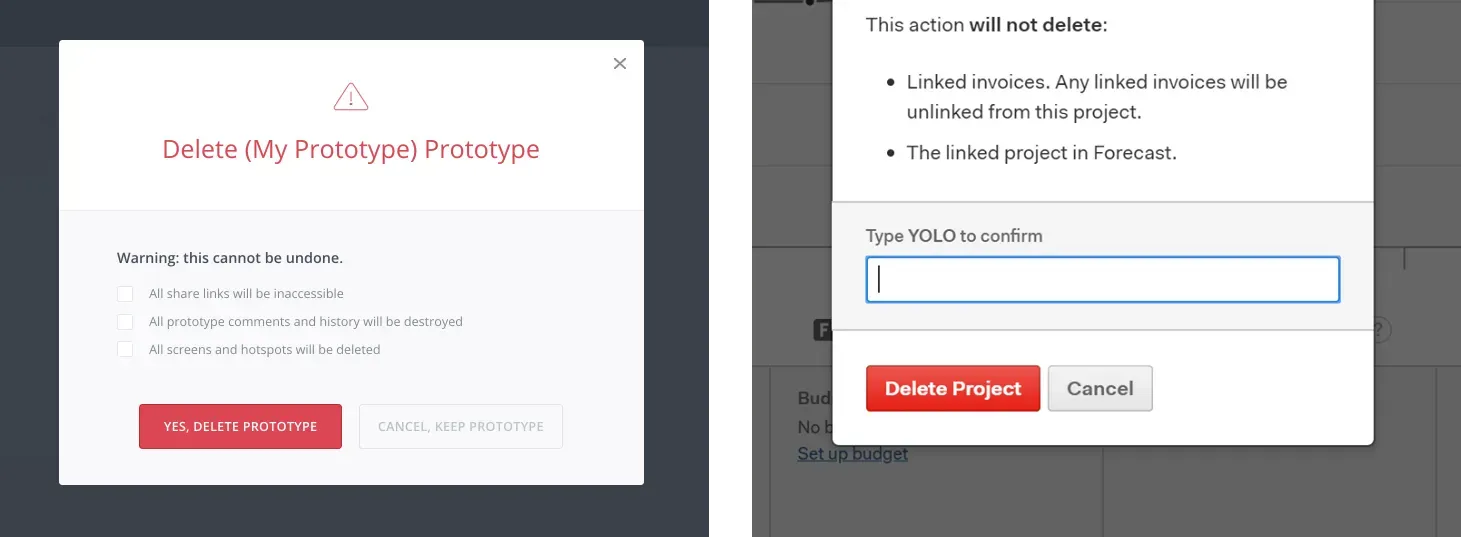
Stopping and thinking about what you're doing is fundamental to the human experience. It's the whole point of Tom and I using a cohort-based approach to the TechFreedom programme. But it's also the opposite of what Big Tech wants.
In an article entitled Frictionless UX Isn’t Always Better, Jeff Link cites some authoritative voices on the subject:
“I think about friction as pacing,” said Antonio García, head of design at Table XI, a Chicago-based product innovation firm. “And where it’s appropriate to be intentional and deliberate in how someone moves through a digital experience.”
“Is it friction? Or is it reflection?” asked Rosa Arriaga, an associate professor at Georgia Institute of Technology’s School of Interactive Computing, who has applied psychological theories to examine how mobile technology can improve asthma and diabetes management.
“Being reflective and reflecting on a given process necessarily leads to a better understanding,” she continued. “If we think about cognitive behavior therapy, the gold standard of mental health, there is an aspect of reflecting on what, at a very basic level, is stressing you out. And that, necessarily, means that you have to stop and think
That question from Rosa Arriaga feels like the right one: Is it friction? Or is it reflection?”
If you want to go further down that rabbit hole, Michael Buckley’s piece on the cognitive cost of convenience makes a similar case in UX terms, arguing that the pursuit of simplicity and friction reduction erodes understanding and autonomy.
Making a case for “productive friction”
Just as with my work on ambiguity, I've found there are different kinds of friction. The best kind of friction is “productive”. That is to say, it increases human agency rather than diminishing it.
To be clear, I'm not arguing for bad design, clunky systems, or making life harder just for the sake of it. I'm juts saying that there are certain kinds of ease which can leave us uncritical, and other kinds of effort which helps us become more capable.
There's some research behind this as well. A 2025 study from the University of Twente on the impact of friction on customers compared low, moderate, and high-friction checkout flows. Low friction was described as “smooth but shallow,” high friction led to frustration and emotional decline, and moderate friction produced the most meaningful cognitive engagement and reflection.
“Productive friction” isn't my phrase. I came across it recently in an article about educators in the age of AI as friction architects:
Productive friction [...] can also be defined as the desirable difficulties; the mental hurdles where actual learning occurs.
- Synthetical struggle: The effort required to connect two opposing arguments found within a transcript.
- Active interrogation: Critiquing an AI-generated summary to identify nuances or hallucinations it might have missed
- Retrieval practice: The difficult, yet essential, work of recalling a concept from memory rather than relying on an instant AI prompt.
Unproductive friction drains a student’s cognitive RAM, leading to burnout and disengagement. Productive friction is where the neural pathways of expertise are built.
[...]
A friction architect doesn’t reject AI; they use it as a precision tool to clear the unproductive weeds so the student has the energy to tackle the productive heavy lifting.
Studies evaluating the impact of fully offloading tasks show significant negative consequences, with learning outcomes observed to be reduced by 22%.
Therefore, instead of asking, "How do I stop my students from using AI?" the friction architect asks: "how can I use AI to offload the unproductive friction so I can demand more rigorous thinking?"
This links to something I've been talking about recently over on Thought Shrapnel. The chart below is a reinterpretation of one that Philippa Hardman discussed as showing how AI can be used well to increase learner capacities.
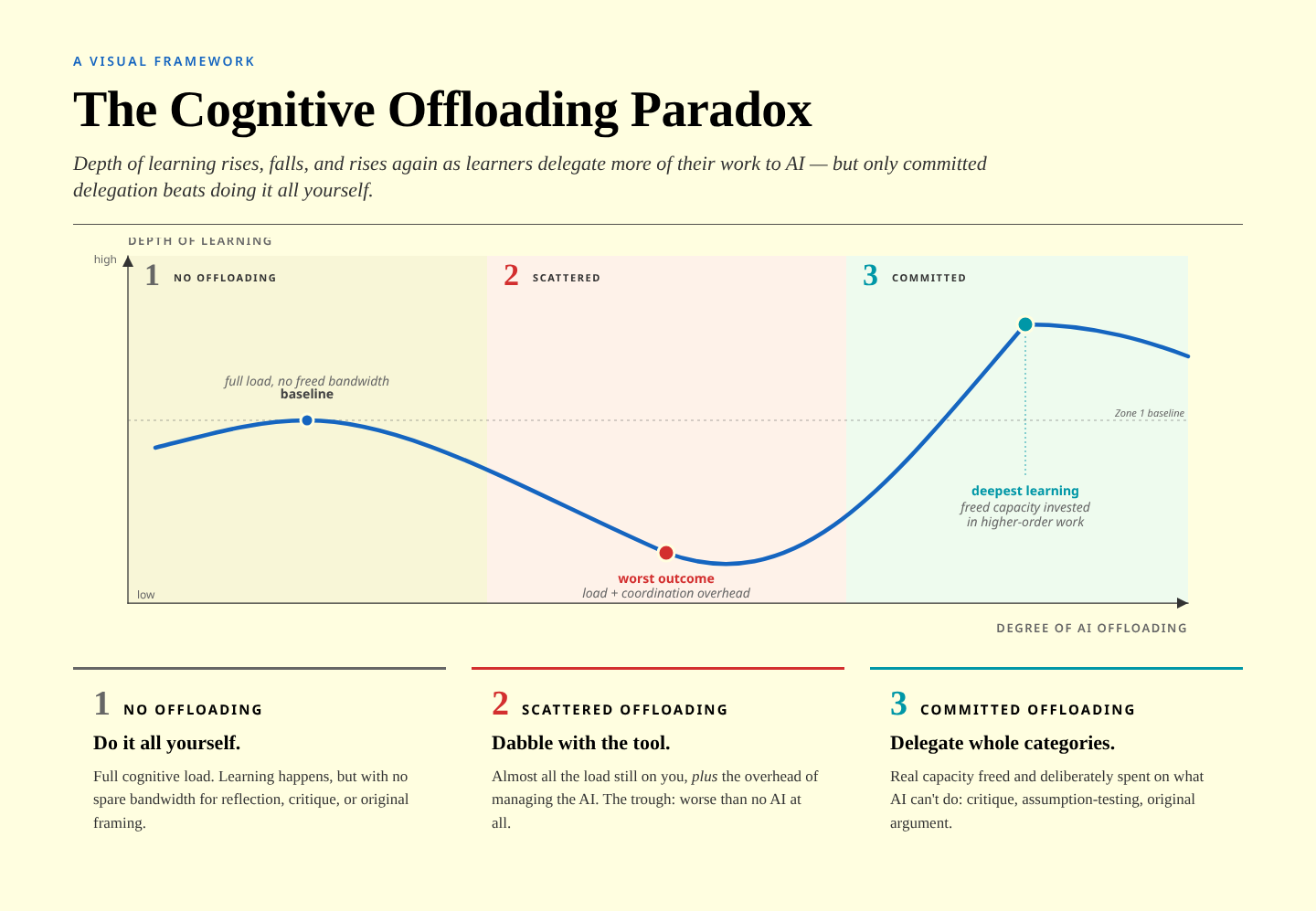
So there is a sweet spot. Too much friction and people give up, but too little and they drift. Somewhere inbetween is a productive space where we remain awake and alive to what we're actually doing.
Literacy and agency
If digital literacy, web literacy, or critical AI literacy mean anything, then it's that use is not fluency. The point is not to “operate tools more efficiently” but to notice structures, question defaults, and understand the incentives which prompt certain behaviours. We don't encourage and enable these kinds of capacities by perfectly smooth experiences.
Once you've read this post, you'll start seeing elegant consumption everywhere: social platforms removing friction from sharing, liking, and scrolling (because speed serves their bottom line); one-click purchasing removing friction from buying (because conversion serves the business model); consent theatre removing friction by reducing the moments in which a person might stop and ask what is actually going on.
As one of our participants noted at the end of the TechFreedom session, they've unquestioningly adopted the language of marketers. The need for a “frictionless experience” isn't language they would naturally use, but instead a phrase that they have been taught.
Sometimes the highest good is not an uninterrupted flow from intention to completion. Sometimes the more human outcome – the one that promotes agency – is the one that introduces a pause that's long enough to notice, judge, reconsider, and perhaps to choose differently.