Why I re-read Montaigne on a regular basis
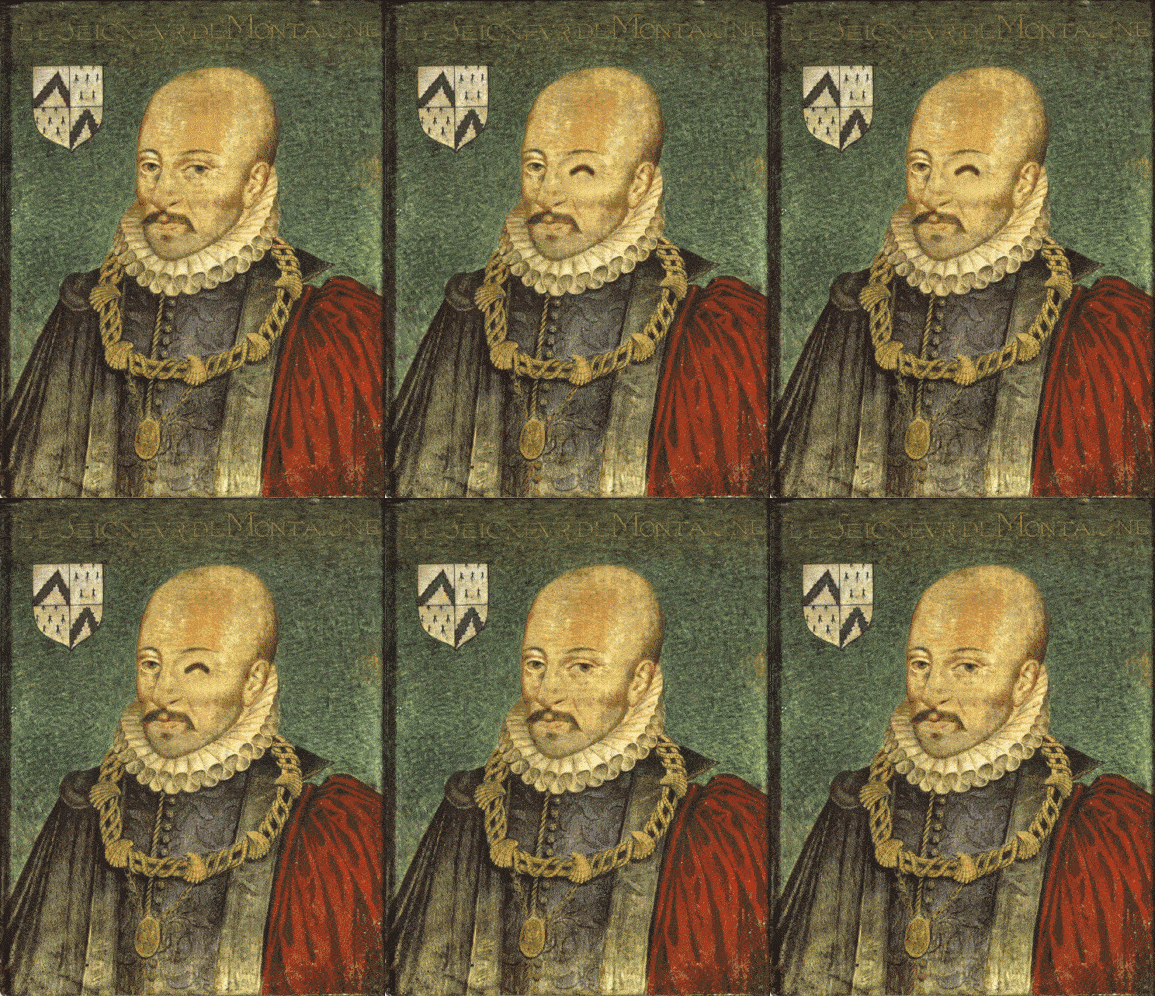
Earlier this week, I submitted a proposal for the Reclaim Open conference. Confused by the "every proposal is also a blog post" guidelines, I thought I had to have the blog post ready at the time of submitting a proposal. This turned out not to be the case, but I'd written it nonetheless.
My submission is entitled Things change (or, Montaigne and the Open Web) and I guess you'll have to wait until November to read it. The good news, however, is that I collected way more Montaigne quotations from my years of re-reading the Essays than I could use in that blog post. So I'm going to take the opportunity of writing more here.
Let's back up a bit. Who was this 16th-century French guy?
Michel de Montaigne was one of the most significant philosophers of the French Renaissance. He is known for popularising the essay as a literary genre. His work is noted for its merging of casual anecdotes and autobiography with intellectual insight. Montaigne had a direct influence on numerous writers of Western literature; his Essais contain some of the most influential essays ever written. (Wikipedia)
In other words, if you haven't read any Montaigne yet, I would highly recommend doing so. I have, and would suggest obtaining, the Penguin edition of the Essays in both paperback and ebook formats. Legally or illegally, that version (translated by M.A. Screech) is currently available on archive.org. Various places, including Project Gutenberg and Wikisource have the public domain version (translated by Charles Cotton). All of my quotations in this post come from the M.A. Screech translation.
I'm sure most people who read Montaigne's work think this, but he and I would have got along well had we coexisted at the same time. Friendship was important to Montaigne and he wrote it about it often in the Essays, perhaps because he missed his friend Étienne de La Boétie so much. Their four-year friendship before the latter's death died aged 32 had a profound effect on Montaigne.
La Boétie's Discourse on Voluntary Servitude, which he wrote while at university, is worth reading in its own right. He was definitely an anarchist, with his key message being that, as we have governments, people don't really desire freedom (hence "voluntary servitude"). He believed in civil disobedience, and I'd thoroughly recommend reading his Discourse, especially in the times we live in.
Despite Montaigne inheriting land and a title, and also being (at least pragmatically) a royalist, he also comes across as somewhat of an anarchist:
I dislike all domination, by me or over me. Otanes, one of the Seven who had rightful claims to the throne of Persia, took a decision which I could well have taken myself. To his rivals he abandoned his rights to be elected or chosen by lot, on condition that he and his family could live in that empire free from all domination, and from all subordination except to those of the ancient laws, and should enjoy every freedom not prejudicial to those laws, since he found it intolerable both to give or to accept commands. ('On high rank as a disadvantage')
Having achieved many honours and held various public offices as well as running his estate, Montaigne decided to shut himself away from the world in his library. Interestingly, the tower in which the library was housed is still standing and open to visitors, where presumably you can see the following inscription on the bookshelves in the room in which he worked:
In the year of Christ 1571, at the age of thirty-eight, on the last day of February, his birthday, Michael de Montaigne, long weary of the servitude of the court and of public employments, while still entire, retired to the bosom of the learned virgins, where in calm and freedom from all cares he will spend what little remains of his life, now more than half run out. If the fates permit, he will complete this abode, this sweet ancestral retreat; and he has consecrated it to his freedom, tranquility, and leisure.
Although his essays were originally intended to be reflections on war and history, as he continued to write, publish, and receive feedback, they became increasingly personal. Some have suggested that, lacking the intimate friendship with La Boétie, he poured his heart and soul into his writings:
For this project of mine it is also appropriate that I do my writing at home, deep in the country, where nobody can help or correct me and where I normally never frequent anybody who knows even the Latin of the Lord’s Prayer let alone proper French. I might have done it better somewhere else, but this work would then have been less mine: and its main aim and perfection consists in being mine, exactly. I may correct an accidental slip (I am full of them, since I run on regardless) but it would be an act of treachery to remove such imperfections as are commonly and always in me. ('On some lines of Virgil')
Although Montaigne was, by all accounts, easy to get along with, reliable, and stable in terms of personality, it sounds like he had some issues to deal with. Like me, it seems like he had some struggles with his mental health:
Once upon a time I used to mark as exceptional the dark, depressing days: those days are now my routine ones; it is the ones which are beautiful and serene which are extraordinary now. ('On some lines of Virgil')
Despite, or perhaps because of, this his reflections seem evergreen. For example, the following is equally applicable to me, almost five centuries later:
If you do not first lighten yourself and your soul of the weight of your burdens, moving about will only increase their pressure on you, as a ship’s cargo is less troublesome when lashed in place. You do more harm than good to a patient by moving him about: you shake his illness down into the sack, just as you drive stakes in by pulling and waggling them about. That is why it is not enough to withdraw from the mob, not enough to go to another place: we have to withdraw from such attributes of the mob as are within us. It is our own self we have to isolate and take back into possession. ('On solitude')
Although he was writing almost five centuries ago, I can't think of too many other thinkers who have the perfect mix of being well-educated (his first language was Latin!), successful, self-reflective, humble, and utterly candid. Reading sections such as the following help me when I'm trying to make sense of my career, or just my life in general:
Those who strive to account for a man’s deeds are never more bewildered than when they try to knit them into one whole and to show them under one light, since they commonly contradict each other in so odd a fashion that it seems impossible that they should all come out of the same shop. ('On the inconstancy of our actions')
It's perhaps a mark of getting older, but one of the things I've found myself doing – whether here or over at Thought Shrapnel – is no longer making any great claims about the way world is; there are only things as they appear to me. Citing Cicero, an author who I can personally take or leave, Montaigne says:
In Rome, the legal style required that even the testimony of an eye-witness or the sentence of a judge based on his most certain knowledge had to be couched in the formula, "It seems to me that…" ('On the lame')
I've found myself using similar constructs, saying "in my opinion..." and "my experience is..." not only in my writing, but in my interactions with others, too. What do I know? As Socrates pointed out, as you become more knowledgeable, you realise that you don't know much, really.
I'll leave you with another apt quotation from Montaigne, that people should probably stick to writing about things they know something about. As he says "many great inconveniences arise" from generalising from one or two non-illustrative examples:
I wish everyone would write only about what he knows – not in this matter only but in all others. A man may well have detailed knowledge or experience of the nature of one particular river or stream, yet about all the others he knows only what everyone else does; but in order to trot out his little scrap of knowledge he will write a book on the whole of physics! From this vice many great inconveniences arise. ('On the Cannibals')