TechFreedom and the risks hiding in your tech stack

Today, Tom Watson and I are inviting people like you to sign up for TechFreedom, a short cohort-based programme to help you see the storm clouds gathering over your tech stack.
Most organisations can't see what's gathering overhead. You depend on platforms that set the terms, change their rules without warning, and leave you exposed when conditions change.
TechFreedom is a three-session programme for social purpose organisations who want to understand their technology risks and do something about them. Working as a small cohort, you'll audit the tools you rely on, explore practical alternatives, and leave with a plan for reducing your dependency on Big Tech.
As I've been writing about recently, it turns out that getting people off US-based Big Tech is harder than just presenting them with a list of alternatives. We have to go beyond just thinking about where data centres are located, and think about which country's laws control your data.
Tom and I have been talking about this for a while, and as I wrote in my last post about this project, we're focusing on:
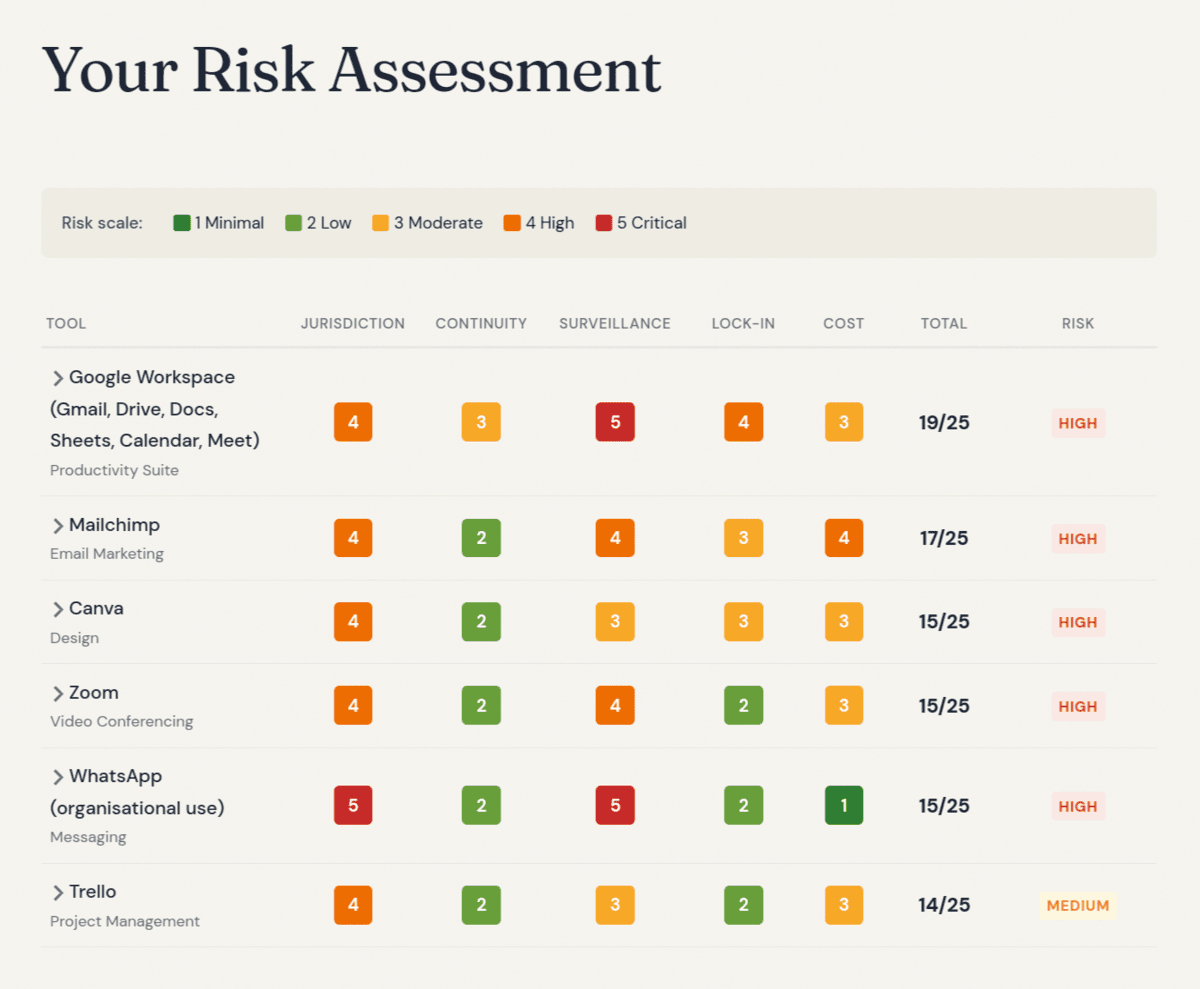
- Jurisdiction – Where does your data actually live? Under whose laws?
- Business continuity – What happens when a platform changes the rules?
- Surveillance – How much does your tech stack know about you?
We'll also be factoring in cost and vendor lock-in, which you can get a feel for by taking the free assessment of your organisation's current risk profile.
It's a journey, not a destination
I am on this journey myself. As I help close down the co-op which I've been part of for a decade, I'm thinking careflly about the tools I'm using for Dynamic Skillset. My consultancy business actually pre-dates the co-op, so the decisions I made back in early 2015 need to be revisited for the post-pandemic world.
Like many people, I've come to realise that my mental models are out of date around tech and risk, and so I'm making adjustments as I recalibrate. So far, I've moved from Google to Proton for my business email, calendar, and documents. This has been the right move for me, but has meant that I've had to figure out some workarounds – creating a browser extension and a scheduling tool that fits my workflow.
It's clear that many co‑ops, charities, unions, and public‑interest organisations need more than blog posts to help them reduce the risks in their technology stack. TechFreedom isn't about providing 'answers' or a technical audit, it's a small‑cohort programme to first SEE what's going on (Session 1), ASSESS risks (Session 2), and then PLAN what to do about them (Session 3).
We'll use a Three Horizons approach to organisational change:
- Horizon 1 (Now → 3 months): quick wins, changes you can make without significant investment
- Horizon 2 (3–12 months): planned transitions, moves requiring coordination, budget, or training
- Horizon 3 (12–24 months): strategic shifts, long-term investments in sovereignty and capability
Our offer will grow and evolve based on feedback from the initial cohort. You will be helping shape the programme, so we have set the price lower for this first group. Places will be limited, so enter your email address on the website for a no‑obligation expression of interest.
Join the pilot cohort
The first session for the pilot cohort will be towards the end of April. Each cohort will be small, so that we can spend time on the specifics of your context rather than just handing over a generic checklist.
If I were you, I would be getting my employer to pay for this. We can invoice your organisation if that is what you need. It's £300 +VAT, with the following cohorts likely to cost significantly more. If you want to take part at this price, now is the time to do it!
Tom and I are particularly keen to hear from co‑operatives, charities, unions, public‑interest tech projects, and public sector teams who recognise themselves in this. If that sounds like you, you can find more details and register your interest – with no obligation – techfreedom.eu.